
If you're a subcontractor working in construction, there's a good chance you've had more tax taken off your pay than you actually owe. That extra money? It's yours to claim back.
The process of claiming CIS refund money isn't complicated once you know what you're doing. This guide breaks it down into five dead-simple steps so you can get your hard-earned cash back in your pocket.
Why You Might Be Owed a CIS Refund
Here's the thing about CIS deductions: they're taken before you get paid, and they don't account for your personal tax allowance or any business expenses you've racked up throughout the year.
The standard deduction rates are:
- 20% for registered subcontractors
- 30% for unregistered subcontractors
These flat-rate deductions often mean you've overpaid. Your actual tax bill is usually lower than what's been taken, especially when you factor in things like tool costs, travel, materials, and your tax-free personal allowance.
"Most subcontractors we work with are owed money back from HMRC: they just don't realise it until they check their numbers."
The good news? You can claim refunds for up to four years after the end of the relevant tax year. So even if you've missed a year or two, you might still be able to get that money back.

Step 1: Gather All Your Paperwork
Before you do anything else, you need to get your documents sorted. This is the foundation of your claim, and missing paperwork is the number one reason refunds get delayed.
What you need to collect:
- Monthly CIS deduction statements from every contractor you've worked for
- Bank statements showing payments you've received
- Receipts for business expenses (tools, materials, travel, PPE, etc.)
- Any Payment and Deduction Statements (PDS) you've been given
Tip: Create a folder: physical or digital: and keep everything in one place. HMRC may ask for proof, and having it ready speeds things up massively.
Don't rely on memory or rough estimates. Contractors sometimes make errors on their end, so your own records are your safety net.
Step 2: Add Up Your Total CIS Deductions
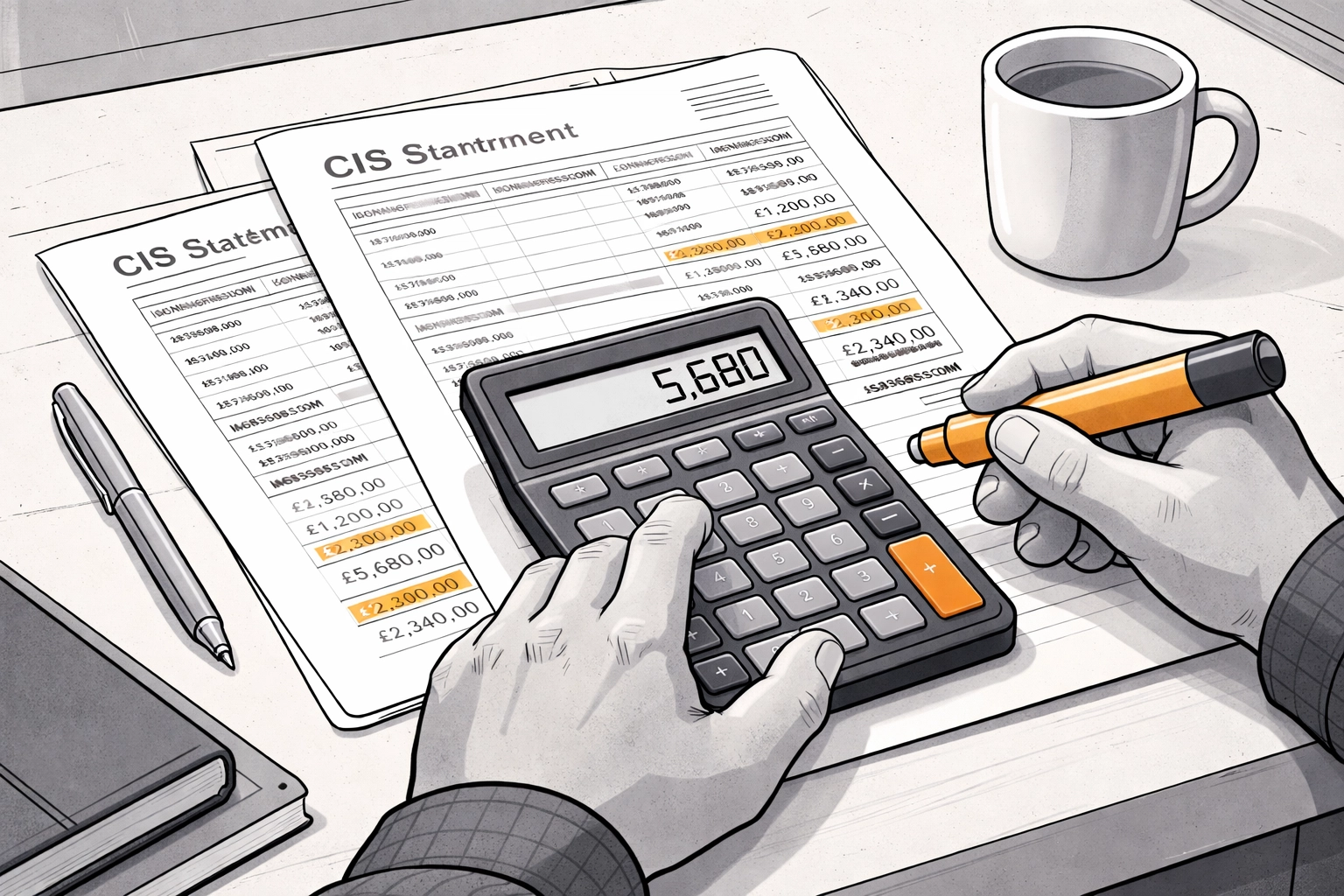
Now it's time to do some maths. Go through all your monthly CIS statements and add up every single deduction that's been taken throughout the tax year.
How to do it:
- Look at each statement from April to April
- Find the "CIS deduction" amount on each one
- Add them all together to get your total
This number is important because it's what you'll compare against your actual tax bill.
Tip: Double-check the figures. If something looks off: like a deduction that seems too high or too low: contact that contractor and ask them to clarify. Mistakes happen, and catching them now saves headaches later.
Step 3: Work Out Your Actual Tax Bill
This is where things get interesting. Your actual tax liability is based on your total income minus your allowable expenses and personal circumstances.
Here's what goes into the calculation:
- Your total earnings for the year (gross income before deductions)
- Allowable business expenses you can claim
- Your personal tax-free allowance (currently £12,570 for most people)
- Any other income or tax considerations
The difference between your total CIS deductions and your actual tax liability is your potential refund.
Example: Let's say you had £8,000 deducted through CIS over the year, but your actual tax bill works out to £5,500. That means you're owed £2,500 back.
"The key is knowing what expenses you can legitimately claim. Many subcontractors leave money on the table because they don't realise things like work clothes, phone bills, and parking can all count."
If numbers aren't your strong suit, this is where getting CIS self-assessment support from a professional can really pay off.
Step 4: Choose How to Claim Your Refund
There are different ways to claim depending on how your business is set up. Pick the method that applies to you.
For Sole Traders and Individuals:
Complete your Self Assessment tax return as normal. Here's what to do:
- Record your full invoice amounts as income (the gross figures before CIS was taken off)
- Enter your total CIS deductions in the dedicated "CIS deductions" field
- Submit your return
HMRC will automatically calculate any refund due. They'll either offset it against other tax you owe or arrange to pay it back to you.
For Limited Companies:
Claim through your company's monthly payroll scheme:
- Enter your CIS deductions in an Employer Payment Summary (EPS)
- HMRC will take deductions off your PAYE bill and National Insurance
Alternative Option – The CIS40 Form:
You can use this standalone form, but only if:
- Your construction work has completely stopped
- All your other tax affairs are fully up to date
For most working subcontractors, Self Assessment is the way to go.

Step 5: Submit Your Claim and Wait
Once everything's filled in correctly, submit your return before the deadline.
Key dates to remember:
- Paper returns: Must be filed by 31 October
- Online returns: Must be filed by 31 January
- Make sure all deductions are recorded correctly by 5 April
After you submit, HMRC will process your claim. How long this takes depends on a few things:
- How complete and accurate your documentation is
- Whether HMRC needs to ask any follow-up questions
- Current processing times at HMRC
Tip: Claims with complete, accurate paperwork get processed faster. Missing information or errors can add weeks to the wait.
If you need to contact HMRC about your claim, having your CIS registration phone number and reference details handy will speed up the call.
Common Mistakes That Delay Your Refund
Even with a straightforward process, some issues crop up again and again. Here's what to watch out for:
1. Missing or Incomplete Documentation
Without proper records, HMRC can't verify your claim. Keep every statement and receipt.
How to avoid it: Set up a system at the start of the tax year. Don't wait until January to start hunting for paperwork.
2. Errors Between Your Records and Contractor Submissions
If the numbers you report don't match what your contractors have told HMRC, your claim gets flagged for investigation.
How to avoid it: Check your statements against your bank records. If something doesn't add up, sort it out before you file.
3. Filing Late
Late returns can mean penalties and longer waits for your refund.
How to avoid it: Set calendar reminders well before the deadline. Give yourself time to gather everything without rushing.
4. Forgetting Allowable Expenses
Many subcontractors don't claim everything they're entitled to, leaving money on the table.
How to avoid it: Keep a running list of all work-related costs. If in doubt, ask a professional whether something counts.
Quick Summary
Claiming your CIS refund doesn't have to be stressful. Here's the process in a nutshell:
- Gather your documents – statements, bank records, expense receipts
- Add up your CIS deductions – every penny taken throughout the year
- Calculate your actual tax bill – income minus expenses and allowances
- Choose your claiming method – usually Self Assessment for sole traders
- Submit and wait – complete paperwork means faster processing
You've got four years to claim, so even if you've missed previous years, it's not too late.
Let CIS Assist Handle It For You
Look, we get it. After a long week on site, the last thing you want to do is wrestle with tax forms and HMRC.
That's exactly why CIS Assist exists. We specialise in helping subcontractors claim back every penny they're owed: with no upfront fees. Our team knows the CIS system inside out and deals with HMRC so you don't have to.
Ready to see what you're owed? Get in touch today and let us take the hassle out of claiming your CIS refund.